

Your team’s best AI automation is stuck in one person’s chat
If you’ve used AI assistants at work for a while, you’ve seen this one: someone sets up a great scheduled task, like “Every Monday, check accounts renewing in the next 60 days and flag the ones at risk.” Someone else wants to use it. But the instructions live in one person’s assistant. So they copy and paste it, improve it further… and now those improvements only help them. This is fine for individual productivity, but where’s the leverage for an entire team or function? That isn’t a frontier intelligence problem. It’s a structure problem: a scheduled prompt belongs to one person, but most critical business processes span multiple team members who need to contribute, improve and inspect the work.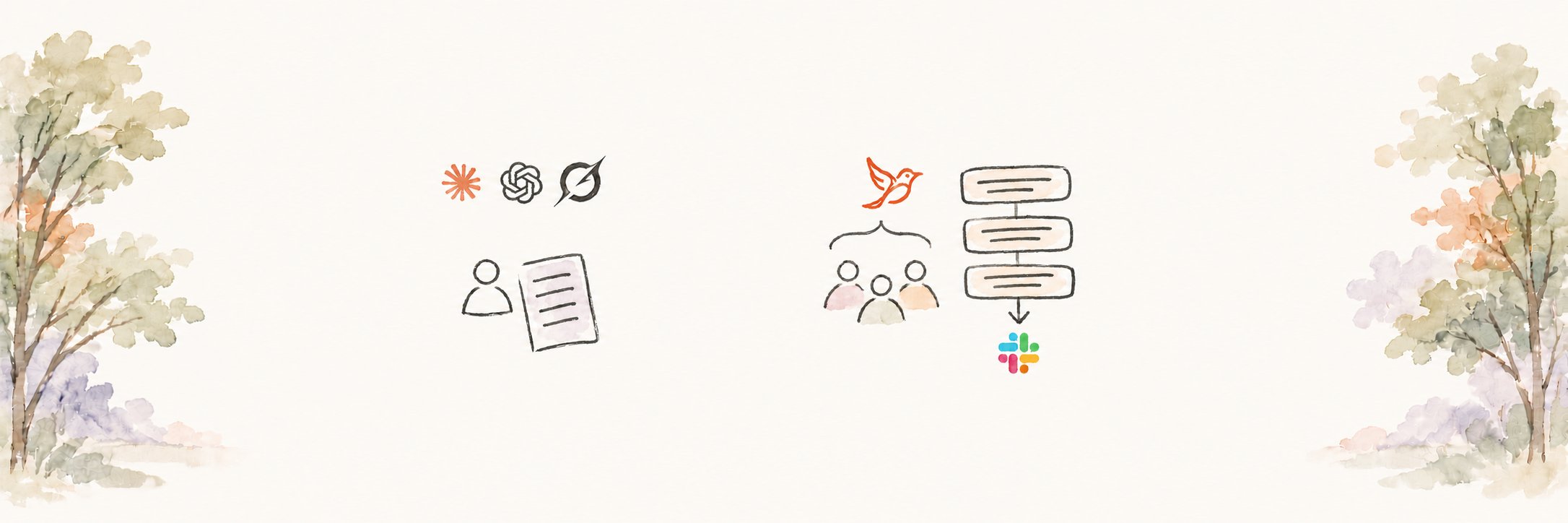
Individual productivity vs team leverage
Grok, Claude Cowork and ChatGPT workspace agents put a powerful general-purpose agent in front of everyone. It can browse, write, analyze and act across your tools, and all three can run work on a schedule. Grok routines can also start from events, like a new Slack message, and ChatGPT workspace agents can be shared within a workspace. For making one person faster, nothing is more capable. Songbird AI loops turn that individual win into team leverage. A loop captures a business process end to end and lives in a shared space. Anyone on the team can read it, contribute to it and improve it, from Slack or from whichever AI assistant they already use, and every improvement helps everyone who relies on it.Scheduled AI tasks vs Songbird loops comparison
When a scheduled AI task is the better choice
- It’s for your own productivity. If nobody else depends on the result, a scheduled task is the simplest option.
- The job is an open-ended exploration, with different steps and outcomes every time. Open-ended work is what a general agent is built for.
- It needs files, browsing websites, or a long back-and-forth chat session. A full agent can do far more in one open-ended run than a loop’s focused steps.
- You’re still figuring out the process. Try it as a scheduled task first, and turn it into a loop once the team relies on it.
When a Songbird AI loop is the better choice
- The process spans several people. Everyone who contributes to or depends on the work can see the instructions and suggest improvements, so the team’s best ideas end up in one shared process instead of scattered copies.
- Your team uses different AI assistants. Some people live in Claude, others in ChatGPT, Codex or Grok. Everyone can work on the same loops from the assistant they already use.
- The process and results need to be predictable and explainable. Every run follows the same steps, and each step is recorded and visible to the team, so when something looks wrong you can see exactly where it happened.
- You want tighter control over what AI can reach. Each step reaches only the tools it needs, which limits exposure compared with an agent that can reach everything.
- You don’t want to be locked in to one model provider. Loops are instructions that exist independently of the model that runs them, so as your volume grows, you can move to better or cheaper models without rebuilding how your business runs.
The verdict: use both
Scheduled AI tasks make individuals more productive. Loops give the whole team leverage, with tighter security, for the business workflows that shouldn’t live in one person’s account anyway. Keep your favorite assistant for your own work and build the team’s Songbird loops from Claude, ChatGPT, Grok or any agent that supports MCP. See Build from any agent.AI loops for your whole team
Build your first loop from the assistant you already use, and share it with your team in Slack.
Get started with AI loops